
Our inaugural Archive Alive Poetry Contest asked writers to engage the Mouthful of Salt archive in a spirit of conversation and exchange.
Thom C. Addington’s winning poem, Eraminhõ (after David Anson Lee), responds to “Salt in the Envelope” with a meditation on the body as vessel, the persistence of memory, and the spiritual weight of what we carry. Grounded in the cultural significance of the eraminhõ, the poem moves between the physical and the metaphysical with careful attention to form and line.
We spoke with Thom about influence, enjambment, revision, and what it means to write alongside another poem.


Kaycee Painter: First of all, congratulations on winning the inaugural Archive Alive Poetry Contest! What was your first reaction when you received the email?
Thom Addington: Thank you so much! It’s an honor—I honestly thought I’d misread the email! After confirming, I did a victory dance too embarrassing to describe; just picture what you’d imagine any near-elder millennial doing in that situation.\
K: Before entering, were you already familiar with Mouthful of Salt, or did the contest introduce you to our archive?
T: I started following Mouthful of Salt earlier this year when I decided to make an IG account just for my poetry to connect with the writing world.
As a Toni Cade Bambara superfan, I was drawn to the title’s evocation of her masterpiece novel The Salt Eaters, and I really enjoyed what I read in Issue 3 (“Savory”)! When I saw the announcement for the “Archive Alive” contest, I was struck by its thoughtfulness, by how it afforded entrants the opportunity to engage in literary community and writing-as-exchange in a unique way.
K: Your poem responds to another piece from our archive, “Salt in the Envelope.” What first drew you to that particular work, and what made you want to enter into conversation with it?
T: I noticed David Anson Lee’s name in Issue 2 (“Trespass”) and was already a fan of his work (he’s got a particularly beautiful poem, “When the Bison Speak in Static,” online at West Trade Review). Then I read “Salt in the Envelope” and got that peculiar kind of mad that writers get when they read something they wish they’d written themselves!
“Salt in the Envelope” got me thinking about envelopes as both the container of a message and its sign (e.g., we use the envelope to signify email or correspondence). This led me to consider the body as a kind of envelope for the soul and to ask where the soul goes once it’s loosed from it.
K: What was the most difficult part of writing this poem? Was there a particular image, line, or emotion that took the longest to get right?
T: The seventh tercet took me forever to phrase and break. Having my twin brother, Quinton (who is an excellent reader and brutally honest as only those closest to you can be) read the last few drafts was helpful. He kept flagging that tercet as being wonky and its phrasing being less-than-evocative.
like a life. Once-
living flower, kept beautiful
between tree skin.
In those early drafts, the image also felt imported, and I struggled with tacking down what new layer of meaning it added to the poem.
K: One of the first things that struck me about the poem was its lineation. There are several moments where you break lines in the middle of a sentence. Could you tell us about your use of enjambment and how you approached the poem’s structure?
T: I tend toward compression, and I love the tercet’s flexibility, the way it concretely gestures toward the ideational/thematic triangulation happening in a poem (I read Anne Carson’s Eros the Bittersweet once and now everything is about triangulation).
I also wanted to structurally enhance the tension between the expansive energy of the ancestor speaker and its container, the eraminhô. I chose certain breaks to both produce more interesting individual lines and to gesture toward the limit of the eraminhô being reached.
K: Your poem is rich with cultural references that carry tremendous emotional weight. Could you tell us more about eraminhõ, its cultural significance, and how it became central to this piece?
T: An eraminhô is a vessel for the souls of ancestors particular to the inhabitants of the Bijagós Islands off the coast of Guinea Bissau. It is representational (in that it visually evokes the ancestor) and sustaining; therein, the ancestor’s soul will continue to live on if properly remembered and honored.The word “remember” literally means to re-body, and the eraminhô re-bodies the loved one now transitioned to ancestorhood.

A world of narrative possibilities emerges from the question of how we properly remember and honor our ancestors, possibilities explored in texts ranging from the Pixar film Coco to Gayl Jones’s novel Corregidora. Researching the Bijagós Islands’ language, spiritual practices, and kinship systems was not only tremendously rewarding but essential to grounding the poem, giving it specificity and feeling.
K: Looking back now, is there anything about the poem that you see differently than when you first submitted it?
T: The judge for the contest, Nala Washington, pointed out where she read the turn of the poem occurring, and I think she’s absolutely right. I’d thought readers would find it at the seventh tercet, and while I love the eighth, I was worried it might pull readers out of the narrative arc the previous ones had been establishing.
K: Where can readers find more of your work or follow your writing?
T: I’ve been posting my creative life on Instagram at @thomwritingtings, and I have work forthcoming in
Outskirts Literary Journal, Luna Luna, and Dreamboy Book Club !
K: Finally, what advice would you give to writers who are hesitant to enter contests or submit their work?
T: If you’ve written something that you love, that you’re proud of, and that you’ve shared with honest fellow writers for feedback, why not try?
In the best-case scenario, you win, and others can be enriched by your work!
In the worst-case scenario, you don’t win, but you’re no worse off than you were before (aside from some potential ego soreness) and you’ve gained the benefit of time away from a piece, which will give you new insight into/perspective on it.
Zadie Smith delivered this lecture at Columbia (and then published it in Changing My Mind: Occasional Essays) where she shares that the secret to editing your work is “becoming its reader instead of its writer,” gaining the perspective of a “smart stranger” by “forget[ting] you ever wrote [it].”

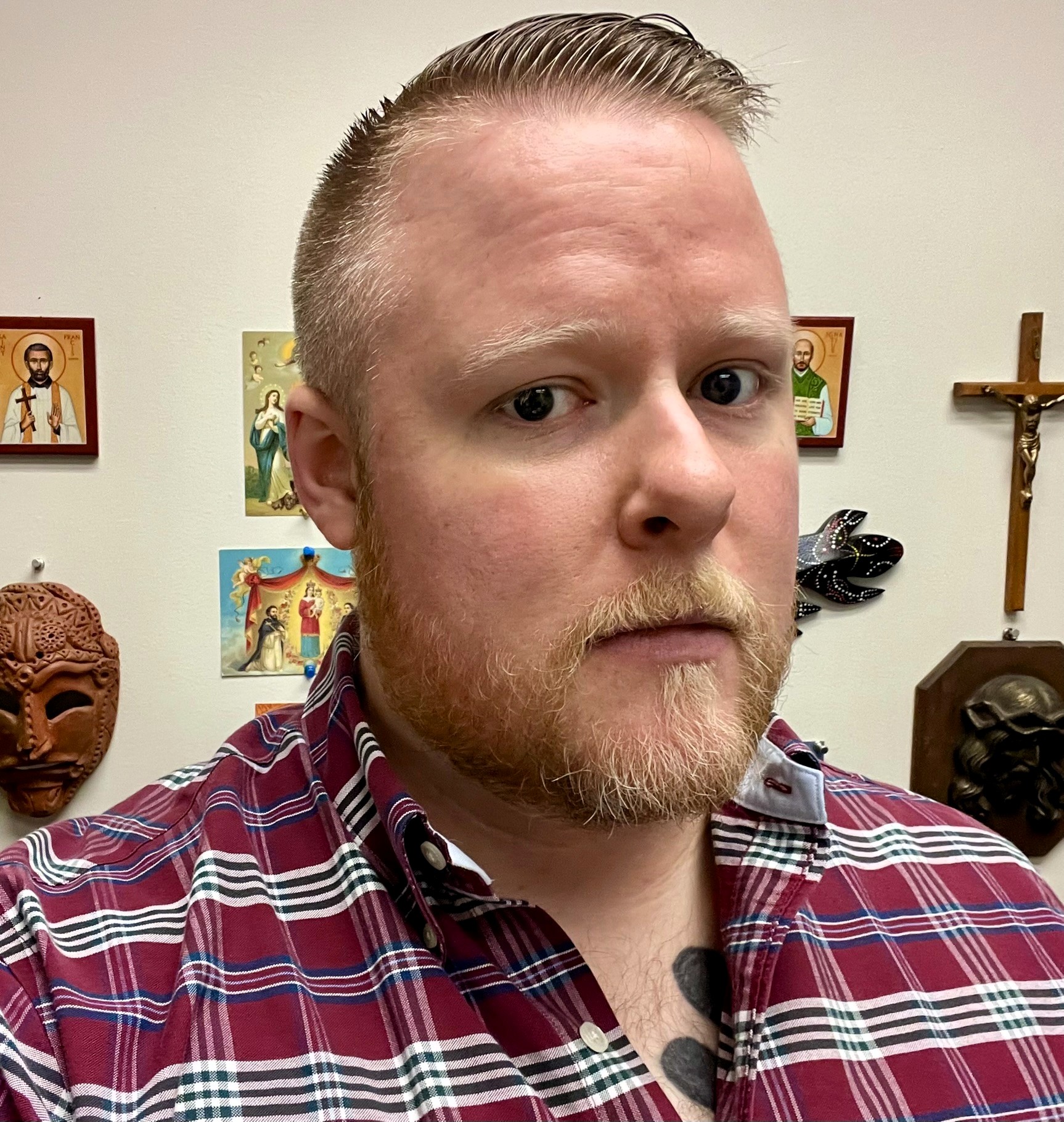
Thom C. Addington (he/him) is a queer, Catholic, rural Southern writer with Appalachian roots raised on Rappahannock land in King & Queen County, Virginia. Thom currently serves as Associate Dean of Humanities & Social Sciences at Reynolds Community College.
Leave a Reply